
The way organizations communicate has changed significantly over the past decade. Conference rooms that once required only a projector and a speakerphone now need to support hybrid meetings, digital collaboration tools, high-definition video, distributed audio, intuitive control, and reliable connectivity. For corporate offices, professional service firms, headquarters, and growing businesses, AV technology is no longer a luxury. It is part of the operational infrastructure that keeps teams aligned, clients engaged, and leadership communication consistent.
Corporate audio visual solutions include far more than displays, speakers, cameras, and microphones. They include the full system design behind the experience: how people enter a room, start a meeting, share content, hear remote participants, present to a client, train employees, or communicate across multiple locations. When corporate AV systems are planned and integrated correctly, the technology becomes simple, dependable, and almost invisible to the user. When they are not, they create friction, delays, inconsistent meetings, and unnecessary support requests.
Organizations planning new offices, renovating existing spaces, or upgrading aging AV systems often face the same challenges. Rooms may not have been designed with audio visual infrastructure in mind. Existing technology may be difficult for employees to use without IT support. Video conferencing may work in some rooms but not others. Audio may be inconsistent. Lighting may look acceptable in person but perform poorly on camera. These issues are rarely solved by purchasing more equipment alone. They require proper system design, thoughtful integration, and an understanding of how people actually use workplace technology.
Audiobahn Professional works with corporate teams, facilities leaders, IT departments, architects, contractors, and business owners to design and integrate practical workplace technology solutions. From conference room AV solutions and boardroom audio visual systems to corporate video conferencing systems, digital signage, lighting control, and AV consulting, the goal is always the same: create systems that support the organization, simplify the user experience, and remain reliable over time.
On This Page
- Understanding AV Requirements for Corporate Environments
- Audio Systems for Corporate Offices
- Video Systems for Corporate Environments
- Lighting Solutions for Corporate Spaces
- The Importance of AV Consulting and System Design
- Common Challenges Corporate Organizations Face
- Planning for Future Technology Needs
- Why Professional Integration Matters
- Frequently Asked Questions
Corporate AV Solutions at a Glance
Every business has different communication needs, but most corporate audio visual solutions include some combination of the following:
- Conference room AV solutions for hybrid meetings and daily collaboration
- Boardroom audio visual systems for executive meetings and client presentations
- Corporate video conferencing systems for remote and distributed teams
- Commercial audio systems for speech reinforcement, paging, and distributed audio
- Digital signage and video walls for internal communication and visitor experience
- Lighting design and control for meeting rooms, offices, and presentation spaces
- Training room technology for onboarding, professional development, and company meetings
- AV consulting and system design for new construction, renovations, and upgrades
Understanding AV Requirements for Corporate Offices & Businesses
Every corporate environment has its own communication rhythms, workflows, and user expectations. A law firm’s conference room serves a different purpose than a technology company’s open collaboration area. A financial firm’s boardroom has different requirements than a manufacturing company’s training center. A nonprofit headquarters may need flexible meeting rooms that support staff gatherings, donor presentations, and livestreamed events. Understanding those distinctions is the starting point for effective office audio visual integration.
Operational goals should drive every technology decision. Before selecting displays, microphones, cameras, speakers, or control systems, it is important to define what each space needs to accomplish. Is the room primarily used for internal meetings? Client presentations? Board meetings? Hybrid collaboration? Training? Video recording? Livestreaming? A system designed around the actual use case will perform better than one built around a generic equipment package.
User experience is equally important. A corporate AV system may be technically capable, but if employees do not feel confident using it, adoption will suffer. Meeting room technology should reduce friction, not add to it. Simple controls, consistent room layouts, clear labeling, and proper training help employees start meetings quickly and use the technology as intended.
Scalability also matters. The collaboration platform an organization uses today may not be the same platform it uses five years from now. Office layouts change. Teams grow. New rooms are added. Systems designed with flexible infrastructure, appropriate cabling, signal distribution, and network coordination are easier and less expensive to update than systems designed around a single device or short-term need.
Audio Systems for Corporate Offices and Meeting Spaces
Audio is often the most important part of any meeting room, even though it is usually the least visible. Poor audio makes communication difficult, increases meeting fatigue, and weakens the experience for both in-room and remote participants. In a corporate setting, speech intelligibility is not just a technical detail. It directly affects productivity, decision-making, client communication, and employee engagement.
Microphone selection and placement require careful planning. Boundary microphones, ceiling microphones, gooseneck microphones, wireless microphones, and beamforming microphone arrays all serve different purposes. The right choice depends on room size, ceiling height, seating layout, surface materials, acoustics, and whether the space supports video conferencing, voice reinforcement, recording, or all of the above.
Digital signal processing, commonly referred to as DSP, plays a central role in professional corporate AV systems. DSP systems manage gain structure, echo cancellation, equalization, noise reduction, mixing, and routing. In conference rooms and boardrooms, proper DSP configuration helps remote participants hear the conversation clearly while preventing echo, feedback, and uneven audio levels.
Distributed audio systems are also common in corporate environments. Offices may need paging systems, background audio, zoned announcements, training room sound reinforcement, or audio distribution across lobbies, corridors, cafeterias, and multipurpose spaces. Proper loudspeaker placement, amplifier selection, and zone control are essential to make these systems useful without being distracting.
Audiobahn Professional’s Audio Systems Integration services address the full range of corporate audio needs, from single-room conference systems to larger facilities with distributed audio, paging, DSP, microphones, and loudspeaker systems. Each solution is designed around speech clarity, reliability, and ease of use.
For organizations evaluating microphone options and speech pickup requirements, Shure’s educational resources provide helpful guidance on professional audio concepts, microphone selection, and best practices for installed systems.
Video Systems for Corporate Environments
Video systems form the visual foundation of modern corporate communication. Displays, projection systems, cameras, video walls, digital signage, and streaming infrastructure all play different roles depending on the space. The right video solution depends on room size, viewing distance, lighting conditions, content type, user expectations, and the organization’s long-term workplace technology strategy.
Conference Room AV Solutions
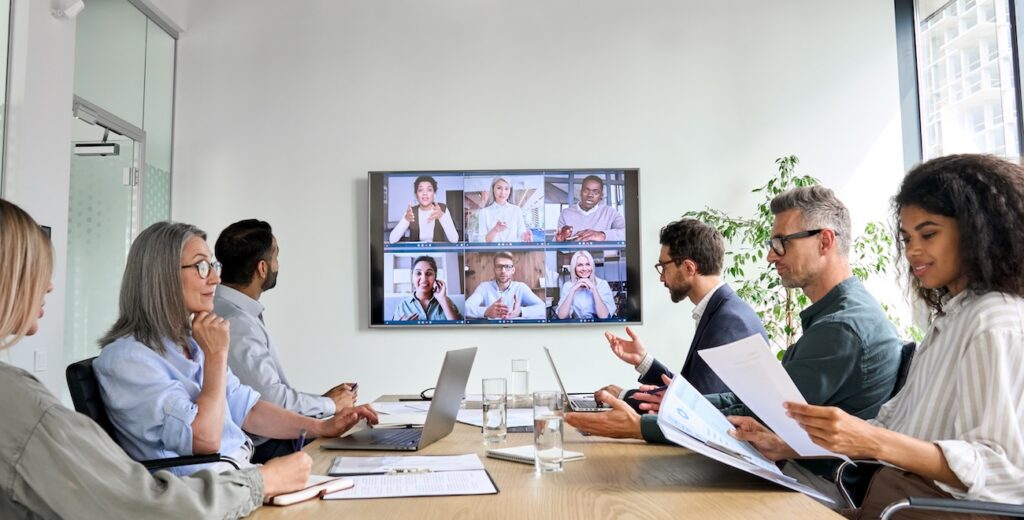
Conference rooms need to support everyday meetings without unnecessary complexity. In many businesses, these spaces must allow users to connect a laptop, launch a video call, share content, view remote participants, and hear everyone clearly. Reliable conference room AV solutions may include displays, cameras, microphones, ceiling speakers, wireless presentation tools, touch panel controls, and integration with Microsoft Teams, Zoom, Google Meet, Webex, or other collaboration platforms.
Boardroom Audio Visual Systems
Boardrooms typically require a higher level of polish and performance. These spaces often host executive meetings, board presentations, client discussions, financial reviews, and strategic planning sessions. A well-designed boardroom audio visual system may include multiple displays, table microphones, ceiling microphone arrays, camera presets, integrated lighting scenes, presentation inputs, and centralized control. The goal is to create a professional experience that feels simple for users while supporting complex communication needs behind the scenes.
Corporate Video Conferencing Systems
Corporate video conferencing systems must support remote participants as full contributors, not afterthoughts. Camera placement, field of view, speaker tracking, microphone coverage, display positioning, and room acoustics all affect the quality of hybrid meetings. Auto-framing cameras and intelligent microphone systems can improve the experience, but they still need to be selected and configured for the specific room.
Digital Signage and Video Walls
Digital signage and video walls support a different set of business goals. In lobbies and reception areas, they can reinforce the brand, welcome visitors, share announcements, display wayfinding information, or highlight company updates. In operations centers, training areas, or multipurpose spaces, video walls can support dashboards, presentations, live feeds, and large-format communication. These systems require careful planning around content management, display brightness, viewing distance, mounting, network connectivity, and long-term maintenance.
Audiobahn Professional’s Video & Livestream Systems Integration services support corporate display systems, video conferencing, livestreaming, video distribution, signage, and presentation technology. For organizations that need to communicate with distributed teams, record training sessions, or broadcast company meetings, proper video infrastructure is essential.
AVIXA, the professional association for the audiovisual industry, provides widely recognized education and standards for AV professionals. Their audiovisual standards resources are useful for understanding how performance expectations are defined in professional AV system design.
Lighting Solutions for Corporate Spaces
Lighting is often treated as a construction or interior design detail, but it has a direct impact on corporate AV performance. A room can look acceptable to the human eye while still producing poor results on camera. Harsh shadows, uneven facial lighting, glare on displays, and excessive backlighting can all degrade the video conferencing experience.
Functional lighting supports the practical use of a space. Conference rooms, boardrooms, training rooms, and presentation spaces need lighting that allows participants to read materials, see one another clearly, and remain comfortable during extended meetings. For video conferencing, lighting should be balanced, diffuse, and coordinated with camera positioning.
Architectural and accent lighting contribute to the overall impression of a corporate environment. Executive boardrooms, reception areas, client presentation rooms, and multipurpose spaces often benefit from lighting scenes that support different modes of use. A single space may need bright lighting for collaboration, dimmed lighting for presentations, and warmer accent lighting for client receptions or informal gatherings.
Lighting control integration can also improve usability and efficiency. Scenes can be tied to presentation mode, video conferencing mode, occupancy sensors, or room scheduling systems. When lighting, displays, shades, and AV controls work together, users can prepare a room for a meeting or presentation with a single action.
Audiobahn Professional’s Lighting Design & Installation services help businesses plan functional, architectural, accent, and presentation lighting that supports both the in-person experience and the camera experience. For corporate offices, this is especially important in rooms where executives, clients, or remote teams interact regularly.
The Importance of AV Consulting and System Design
The most expensive AV problems often begin before equipment is ordered. A display location may be chosen without considering sightlines. A conference table may be selected without accounting for microphone placement. Electrical and conduit pathways may be installed before AV infrastructure is designed. Ceiling conditions may limit speaker or microphone options. Lighting may be designed without considering video conferencing. These issues can be corrected later, but usually at a higher cost.
A professional AV consulting process helps organizations make better decisions earlier. A needs assessment identifies what each space must accomplish. A site evaluation documents room dimensions, acoustic conditions, infrastructure, network requirements, ceiling conditions, and user expectations. Budget planning helps leadership understand priorities, phasing options, and realistic project costs.
AV consulting is especially valuable for new construction, office renovations, headquarters projects, and multi-room upgrades. Early involvement allows the AV consultant to coordinate with architects, contractors, IT teams, electrical contractors, furniture vendors, and facilities staff. This coordination helps reduce change orders, avoid design conflicts, and ensure that the finished system supports the intended use of the space.
Long-term planning is another major advantage. Technology has a lifecycle. Displays, cameras, microphones, control processors, collaboration platforms, and network infrastructure do not all age at the same rate. A thoughtful AV design considers what should be easy to upgrade later and what infrastructure should be built to last.
Audiobahn Professional’s AV Consulting Services are available for organizations that need planning guidance before beginning a full commercial AV installation. Consulting can help businesses evaluate existing systems, plan future upgrades, understand budget ranges, and avoid costly design mistakes.
Extron also provides professional education around AV infrastructure, signal distribution, and system design. Their training and education resources are useful for understanding the technical planning behind modern AV environments.
Corporate AV Solutions by Space Type
Corporate audio visual solutions should be tailored to the room type and the people using the space. A small huddle room should not be designed the same way as an executive boardroom, and a training room should not be treated like a standard meeting room. Matching the technology to the space is one of the most important steps in effective office audio visual integration.
Executive Boardrooms
Executive boardrooms often require high-quality audio, professional camera coverage, large-format displays, controlled lighting, and reliable presentation technology. These spaces may support confidential meetings, leadership presentations, investor discussions, board votes, and hybrid executive sessions. The system should feel polished, but it also needs to be simple enough for leadership teams to use without technical assistance.
Conference Rooms
Conference rooms are the daily workhorses of most businesses. They need to support quick meetings, screen sharing, video calls, internal presentations, and collaborative decision-making. Consistency is important. When conference room AV solutions are standardized across multiple rooms, employees spend less time learning different systems and more time communicating effectively.
Huddle Rooms and Small Collaboration Spaces
Smaller rooms require thoughtful design because space is limited. Camera placement, display size, microphone pickup, and speaker location all need to be scaled appropriately. Overbuilding these rooms can make them unnecessarily expensive, while underbuilding them can create frustrating meeting experiences. The right design balances simplicity, reliability, and cost.
Training Rooms
Training rooms often need more flexible technology than standard conference rooms. They may support instructor-led sessions, remote learners, recorded training, live streaming, wireless microphones, multiple displays, and content sharing from several sources. Acoustics, sightlines, lighting, and control systems are especially important in rooms used for extended sessions.
Reception Areas and Lobbies
Reception areas are often the first impression a visitor has of a business. Digital signage, background audio, architectural lighting, and video walls can support wayfinding, branding, announcements, and visitor engagement. These systems should feel integrated into the environment rather than added as an afterthought.
Multipurpose and Town Hall Spaces
Many organizations need flexible spaces that support all-hands meetings, company updates, client events, training sessions, and internal presentations. These environments may require speech reinforcement, projection or LED displays, livestreaming capabilities, lighting scenes, wireless microphones, and flexible control. Reviewing recent AV integration projects can help organizations understand how similar spaces can be designed to support multiple use cases.
Common Challenges Corporate Organizations Face
Corporate AV systems often fail to meet expectations because they were designed around equipment instead of outcomes. The following challenges are common, but they can usually be addressed through proper assessment, design, and integration.
Inconsistent Room Technology
Many businesses add rooms over time, resulting in a patchwork of different displays, cameras, microphones, control interfaces, and conferencing platforms. This creates confusion for employees and increases the burden on IT support. A standardized approach, scaled by room type, creates a more predictable user experience and simplifies maintenance.
Poor Acoustic Conditions
Hard surfaces, glass walls, open ceilings, HVAC noise, and untreated rooms can all reduce speech intelligibility. While DSP can help manage some problems, it cannot fully compensate for a poorly designed acoustic environment. Acoustic evaluation should be part of the planning process for conference rooms, boardrooms, and training spaces.
Weak Remote Meeting Experiences
Hybrid meetings often fail when remote participants cannot hear clearly, see the right people, or follow the conversation naturally. Better cameras, microphones, displays, and room layouts can improve the experience, but the full system must be designed together. A strong corporate video conferencing system considers both the in-room and remote participant experience.
Inadequate Network Infrastructure
Modern AV systems are increasingly network-dependent. Video conferencing, digital signage, control systems, streaming, and AV-over-IP technologies all rely on network performance. Coordination between the AV integrator and IT team helps ensure that bandwidth, VLANs, quality of service, security requirements, and support responsibilities are clearly addressed.
Low User Adoption
Even high-quality systems can fail if users do not understand how to operate them. Intuitive controls, consistent room standards, clear documentation, and user training all improve adoption. Commercial AV installation should include commissioning and training, not just equipment placement.
Planning for Future Technology Needs
Hybrid work has changed what businesses expect from meeting room technology. Remote participants need to be seen, heard, and included. In-person participants need to collaborate without fighting the technology. Leaders need spaces that support internal communication across offices, departments, and distributed teams.
Scalability should be part of the design conversation from the beginning. Businesses may begin with a few conference rooms and later expand to additional floors, new locations, or more advanced video conferencing systems. Systems designed with flexible infrastructure make these future upgrades more manageable.
Technology lifecycle planning also helps organizations manage costs over time. Displays may remain useful for many years, while conferencing hardware and collaboration platforms may evolve more quickly. Cabling and infrastructure often last longer than active equipment. Understanding these differences allows businesses to plan phased upgrades rather than unexpected replacements.
Remote participation, livestreaming, recording, and company-wide communication are likely to remain important for many organizations. Even businesses that do not currently produce live content may eventually need to stream town halls, record training sessions, or support executive broadcasts. Planning for these possibilities early can prevent major infrastructure changes later.
What Organizations Should Look for in an AV Integration Partner
Choosing the right AV integration partner is as important as choosing the right technology. Corporate AV systems affect daily operations, employee experience, client communication, and long-term facility performance. The integration partner should be able to provide more than a product list.
A qualified AV partner should understand system design, acoustics, video conferencing, control systems, lighting, network coordination, installation practices, commissioning, documentation, and user training. They should also be able to communicate clearly with business leaders, IT teams, facilities staff, architects, and contractors.
Organizations should look for an integrator that asks detailed questions before recommending equipment. What problems are you trying to solve? Who uses the rooms? What platforms do you rely on? What does success look like for remote participants? What infrastructure already exists? What needs to be standardized? What needs to remain flexible?
The National Systems Contractors Association provides resources for the commercial integration industry and is a helpful authority for organizations learning about professional systems contractors, integration practices, and industry standards.
Why Professional Integration Matters
The difference between a professionally integrated AV system and a basic equipment installation becomes most apparent after the system is in daily use. Professional integration accounts for the physical room, the user experience, the IT environment, the acoustic conditions, the lighting, the long-term support plan, and the organization’s communication goals.
Reliability is one of the most important benefits. Professionally designed systems are engineered, installed, tested, commissioned, and documented. This reduces support issues and makes troubleshooting easier if something does need attention. Documentation also helps internal IT or facilities teams understand how systems are connected and configured.
User adoption is another critical factor. A system that employees understand and trust is more likely to be used. Training, simple controls, standardized workflows, and clear documentation help users feel confident. When technology is difficult or inconsistent, employees often avoid it or create workarounds that reduce the value of the investment.
Professional integration also supports long-term return on investment. Meeting rooms that work reliably reduce wasted time. Boardrooms that present well support executive communication and client confidence. Training rooms that function properly improve employee development. Digital signage and workplace communication systems help organizations share information more effectively.
Audiobahn Professional supports businesses nationwide with commercial AV installation, corporate collaboration technology, meeting room technology, lighting integration, and AV consulting. Whether your organization is upgrading existing rooms or planning a new facility, the right integration process can help reduce risk and improve long-term system performance.
Discuss Your Corporate AV Project
If your organization is planning a new office, renovating meeting spaces, upgrading corporate video conferencing systems, or replacing outdated workplace technology, Audiobahn Professional can help evaluate your needs and develop a practical technology roadmap. The process begins with understanding how your team communicates, what your rooms need to support, and where your current systems are creating friction.
Explore Audiobahn Professional’s project portfolio to see examples of completed AV integration work, or contact Audiobahn Professional to schedule a consultation for your corporate audio visual solutions.
Frequently Asked Questions
Corporate audio visual solutions are the systems businesses use to support meetings, presentations, video conferencing, internal communication, training, digital signage, and collaboration. These systems may include displays, cameras, microphones, speakers, DSP, lighting control, digital signage, control panels, livestreaming equipment, and network-connected AV infrastructure.
Common signs include frequent technical issues, poor audio quality, unreliable video conferencing, outdated displays, inconsistent room controls, employee complaints, or recurring IT support requests. If users avoid certain rooms because they are difficult to operate, an AV assessment is a good next step.
The timeline depends on the number of rooms, complexity of the systems, equipment availability, construction schedule, and level of customization. A single conference room may be completed relatively quickly, while a multi-room office, headquarters, or campus-wide deployment typically requires a longer design, procurement, installation, and commissioning process.
AV systems should be planned as early as possible, especially for new construction and renovations. AV design affects conduit, electrical, ceiling coordination, display placement, furniture layout, acoustics, network infrastructure, lighting, and control systems. Early planning helps reduce costly changes later.
Yes, in many cases. Existing cabling, displays, speakers, or infrastructure may be reusable depending on their condition and compatibility with the new system goals. A professional assessment can identify what should remain, what should be replaced, and what upgrades are required to meet current expectations.
Corporate AV systems can be designed to support platforms such as Microsoft Teams, Zoom, Google Meet, Webex, and other collaboration tools. Platform requirements should be discussed early because hardware certification, camera behavior, audio processing, and user workflows can vary by platform.
Acoustic treatment is very important when a room has excessive echo, hard surfaces, high ceilings, or background noise. Poor acoustics can reduce speech intelligibility and make remote meetings frustrating. DSP can improve audio performance, but it works best when the room itself is reasonably controlled acoustically.
Ongoing support may include user training, system documentation, troubleshooting, maintenance visits, remote support, firmware updates, and future upgrade planning. For businesses that rely on meeting room technology every day, a clear support plan helps protect the long-term value of the AV investment.